Sunday, August 24, 2008


Tuesday, August 19, 2008
Saturday, July 26, 2008
Tuesday, July 15, 2008
The Push For Quotas For Women In Science
Posted by kdawson on Tuesday July 15, @05:48PM on slashdot.
Monday, June 23, 2008
Hippocratic Oath for Scientists?
Article: Living the Scientific Life
Tuesday, April 22, 2008
Teaching Math
It always happens in every math class that I have taught that one day a student will as me why they need to learn this stuff. They are not impressed with explanations of how math trains their minds to think logically and teaches them to solve problems in a sequential manner by applying properties and theorems. The best answer that I can give my students is that I don’t know. And they don’t either. It depends on them and what they end up doing with their lives. Some of them will probably never use any of it. I am giving them tools to use and it will be up to them to decide if and when to use them.
I look at it as they are on a journey, one that I have already traveled. In high school algebra and geometry, they are at the beginning of a journey that will take them to calculus and higher math. Calculus is the door to a whole new way of looking at the world and leads to an understanding of the way things work. They are beginning a journey that will take them places and allow them to understand things that they haven’t even imagined.
I realize that most of my students will end their journey early and go no further than the basic algebra and geometry that is required for them to graduate from high school. That is fine. Math isn't for everyone. As long as you can make change and balance a checkbook. You probably learn all of the math that you need for normal, everyday life by 6th grade.. But there are a few who will make the journey. They will take the tools that I give them and acquire many more along their journey.
Hopefully, one or two of my students will continue the journey even further than I have gone.
Saturday, March 22, 2008
A New Enerprise

CGI artist Gabriel Koerner has confirmed this is actually one of his designs. I'm really looking forward to the new Star Trek movie next summer. I really don't mind that it is a restart of the original series (TOS), as much as I am a fan of all things Star Trek. I think the modern way of story telling may be what the series needs to get a new generation hooked on making the future happen as much as my generation has been influenced by TOS.
Monday, October 22, 2007
Information R/evolution
Saturday, September 29, 2007
On note taking and other important stuff
Discontinued - Your kidding?
Wow. Look at the HP-50. Nice!
Oops, $149.99?
Um, the TI still works great, and besides, it's not the calculator, its the skill of the operator that counts.
Ya, that'll work.
Sunday, September 23, 2007
Getting Things Done
Sunday, July 29, 2007
Reliving the 80s with Pandora
Sunday, May 20, 2007
What to do?
I'm trying to figure out what I want to accomplish today. I'm a functional procrastinator and if I don't sit down and organize myself in the morning, I'm just kind of random throughout the day. At the end of the day I really don't feel like I have accomplished anything.
I started listening to podcasts from Merlin's Mann's 43 Folders blog and have downloaded a series on getting things done. I started listening to it on my walk last night and it is no surprise that I'm not the only one with this problem. What is surprising is that someone else actually has to time to spend really thinking about this issue. Merlin and his guest must have some very important projects that they are putting off. It seems that it is common to find lots of other things to do (like I am doing now) rather than getting done what needs to be done. The trick seems to be that if you are going to procrastinate getting done what needs to be done by doing other things, make those other things that you do things that need to be done. In other words, waste time with worthwhile activities.
Perhaps I'll finish listening to Merlin's podcast on my walk tonight, if something else doesn't come up.
Friday, November 03, 2006
Solving Karnaugh maps ain't like dustin' crops, boy!
Monday, July 24, 2006

Saturday, December 24, 2005
A Real American Hero
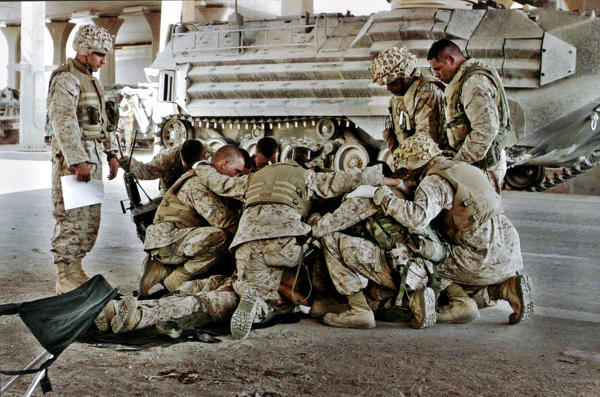
On Oct. 26, 1942: The last man did not fail
Oct. 26 fell on a Thursday this year [2000]. Ask the significance of the date, and you're likely to draw some puzzled looks -- five more days to stock up for Halloween? It's a measure of men like Col. Mitchell Paige that they wouldn't have had it any other way. What he did 58 years ago, he did precisely so his grandchildren could live in a land of peace and plenty.
Whether we've properly safeguarded the freedoms he and his kind fought to leave us as their legacy, may be a discussion better left for another day. Today we struggle to envision -- or, for a few of us, to remember -- how the world must have looked on Oct. 26, 1942. A few thousand lonely American Marines had been put ashore on Guadalcanal, a god-forsaken jungle island which just happened to lie like a speed bump at the end of the long blue-water slot between New Guinea and the Bismarck Archipelago -- the very route the Japanese Navy would have to take to reach Australia.
On Guadalcanal the Marines built an air field. And Japanese commander Isoroku Yamamoto immediately grasped what that meant. No effort would be spared to dislodge these upstart Yanks from a position that could endanger his ships during any future operations to the south. Before long, relentless Japanese counterattacks had driven the U.S. Navy from inshore waters. The Marines were on their own.
World War Two is generally calculated from Hitler's invasion of Poland in 1939. But that's a Eurocentric view. The Japanese had been limbering up in Korea and Manchuria as early as 1931, and in China by 1934. By late 1942 they'd devastated every major Pacific military force or stronghold of the great pre-war powers: Britain, Holland, France, and the United States. The bulk of America's proud Pacific fleet lay beached or rusting on the floor of Pearl Harbor.
As Mitchell Paige -- then a platoon sergeant -- and his men set about establishing their last defensive line on a ridge southwest of the tiny American bridgehead at Henderson Field on Guadalcanal on Oct. 25, it's unlikely anyone thought they were about to provide a definitive answer to that most desperate of questions: How many able-bodied U.S. Marines does it take to hold a hill against 2,000 desperate and motivated attackers?
The Japanese Army had not failed in an attempt to seize any major objective since the Russo-Japanese War of 1895. But in preceding days, Marine commander Vandegrift had defied War College doctrine, "dangling" his men in exposed positions to draw Japanese attacks, then springing his traps "with the steel vise of firepower and artillery," in the words of Naval historian David Lippman.
The Japanese regiments had been chewed up, good. Still, American commanders had so little to work with that Paige's men had only four 30-caliber Browning machine guns on the one ridge through which the Japanese opted to launch their final assault against Henderson Field, that fateful night of Oct. 25.
By the time the night was over, "The 29th (Japanese) Infantry Regiment has lost 553 killed or missing and 479 wounded among its 2,554 men," historian Lippman reports. "The 16th (Japanese) Regiment's losses are uncounted, but the 164th's burial parties handle 975 Japanese bodies. ...The American estimate of 2,200 Japanese dead is probably too low."
Among the 90 American dead and seriously wounded that night were all the men in Mitchell Paige's platoon. Every one. As the night wore on, Paige moved up and down his line, pulling his dead and wounded comrades back into their foxholes and firing a few bursts from each of the four Brownings in turn, convincing the Japanese forces down the hill that the positions were still manned.
The citation for Paige's Congressional Medal of Honor adds: "When the enemy broke through the line directly in front of his position, P/Sgt.Paige, commanding a machine gun section with fearless determination, continued to direct the fire of his gunners until all his men were either killed or wounded. Alone, against the deadly hail of Japanese shells, he fought with his gun and when it was destroyed, took over another, moving from gun to gun, never ceasing his withering fire."
In the end, Sgt. Paige picked up the last of the 40-pound, belt-fed Brownings -- the same design which John Moses Browning famously fired for a continuous 25 minutes until it ran out of ammunition in its first U.S. Army trial -- and did something for which the weapon was never designed. Sgt.Paige walked down the hill toward the place where he could hear the last Japanese survivors rallying to move around his flank, the gun cradled under his arm, firing as he went.
The weapon did not fail.
Coming up at dawn, battalion executive officer Major Odell M. Conoley first discovered the answer to our question: How many able-bodied U.S.Marines does it take to hold a hill against two regiments of motivated, combat-hardened infantrymen who have never known defeat?
On a hill where the bodies were piled like cordwood, Mitchell Paige alone sat upright behind his 30-caliber Browning, waiting to see what the dawn would bring.
One hill: one Marine.
But that was the second problem. Part of the American line had fallen to the last Japanese attack. "In the early morning light, the enemy could be seen a few yards off, and vapor from the barrels of their machine guns was clearly visible," reports historian Lippman. "It was decided to try to rush the position."
For the task, Major Conoley gathered together "three enlisted communication personnel, several riflemen, a few company runners who were at the point, together with a cook and a few mess men who had brought food to the position the evening before.
"Joined by Paige, this ad hoc force of 17 Marines counterattacked at 5:40 a.m., discovering that "the extremely short range allowed the optimum use of grenades." In the end, "The element of surprise permitted the small force to clear the crest."
And that's where the unstoppable wave of Japanese conquest finally crested, broke, and began to recede. On an unnamed jungle ridge on an insignificant island no one had ever heard of, called Guadalcanal. Because of a handful of U.S. Marines, one of whom, now 82, lives out a quiet retirement with his wife Marilyn in La Quinta, Calif.
When the Hasbro Toy Co. called up some years back, asking permission to put the retired colonel's face on some kid's doll, Mitchell Paige thought they must be joking. But they weren't. That's his mug, on the little Marine they call "GI Joe."
And now you know.
The Washington Post
November 18, 2003; Page B06
Mitchell Paige, 85, a retired Marine Corps colonel who received the Medal of Honor after almost single-handedly staving off enemy forces during a crucial battle of World War II, died Nov. 15 at his home in La Quinta, Calif., southeast of Palm Springs.
Thursday, November 10, 2005

Tuesday, October 25, 2005
Thursday, July 14, 2005
Back to Business
I've been seeing a lot more discussion about FPGAs in the literature lately. It looks like they are coming to light as the versatile little buggers that they are. EDN magazine has an interesting little article in the July 7 edition on the image-processing applications of FPGAs. In Embedded Systems Programming magazine (July 2005) the editor has a nice piece about his experiences with FPGAs.
Good news! IEEE Spectrum magazine is reporting in the July 2005 issue that engineering salaries are slowly starting to rise again in the US and are really taking off overseas. Overseas, salaries for engineers are increasing by double digit percents. The drain that has occurred here in the US with engineering jobs seems to be heating up the job market in China and India. Hopefully, some type of near equity will be reached with US engineers and some of the jobs that have been sourced off-shore will start returning.
Computer magazine (July 2005) also has an article on embedded computing and discusses the need for computer science to revisit its foundations and prepare for the 21st century by creating practices that will meet current and projected needs. It will be necessary to reinvent computer science. There are issues of precision and reliability involving temporal issues. We have the basic tools that we need. We just need to start using them. Technology is ready for another leap. The time is just about right for another revolution such as occurred as transistors became ubiquitous.
Friday, July 01, 2005
Star Trek New Voyages

I came across a cool web site for an independent Star Trek fan film production group at Star Trek New Voyages. They have released two films so far that pick up where the original series from the 1960s left off. Captain Kirk and the crew of the Enterprise had completed three years of their five year mission when the series was cancelled and the fan films pick up during the fourth year. All of the original Enterprise crewmembers are portrayed by new actors who give fresh interpretations of the original characters.
The first two episodes “Come What May” and “In Harms Way” were released in 2004. These short films are available free for download from the website in zipped WMA format either through direct download from mirror sites or through bit torrent. Each episode is presented as a teaser and five acts. There are two more films in development and are scheduled for release in 2006. The third film is being written by one of the writers from the original series and will guest star Walter Koenig - Mr. Chekov from the original series and the movies.
I was impressed with the quality of the films considering that they are privately sponsored and produced. There are quite a few computer generated special effects but the look and feel is approximate to the original series plus something a little more. The costumes, props, and sets are very well done. I noticed the improvement between the first episode and the second episode and anticipate again as much improvement in the upcoming episodes. Since Star Trek Enterprise was cancelled and there is no Trek in sight, at least not for a few years, the production of fan films such as New Voyages will do nicely to fill the void for Trekkers such as myself.
I know that there are other fan films in production, some spinning off from the later series such as "The Next Generation." But for me, it's exciting to see Captain Kirk and the Starship Enterprise back in action again - boldly going where no man has gone before.
